Beautiful lettuce being grown at Arbor House’s Sky Farm in Morrisania
The South Bronx Overall Economic Development Corporation (SoBro) has just announced that it is the recipient of a $25,000 grant from the US Department of Agriculture, “to determine the economic feasibility of a Bronx-based cooperative leveraging its combined purchasing power to use locally-sourced fruits, vegetables, and other products in the restaurants’ menu items.”
The Bronx is severely underserved when it comes to healthy eating options whether its restaurants or supermarkets, one factor being the high cost of purchasing such goods as an individual business. This model which SoBro established, called the United Business Cooperative (UBC) combines the collective purchasing powers of these small businesses into one block in the hopes that they can then in turn purchase locally farmed produce as well as other items in order to create healthier menus.
As per the press release issued by SoBro, the organization launched the UBC with 40 local based immigrant-owned mom and pop eateries earlier this year during the Spring.
Now that SoBro has received the grant, they have one year in which to accomplish the following:
Perform feasibility study
Develop healthier menus
Devise a business plan and community impact strategies for the most viable business scenarios
Create a Local Food Integration Resource Guide to influence food strategies among similar low-income restaurant communities throughout New York City and the nation
SoBro also went on to say, “Because so many restaurants that purchase local ingredients tend to serve an elite customer base and use well-known farmers, it will be a game-changer to show stakeholders in the rest of the country that communities with fewer resources and smaller farms can come together and make local food operations affordable to consumers and economically viable for restaurants and farms.”
Pooling resources together has been an unofficial business model of many immigrant communities when they arrive in America and collectively they are able to start up their own business but usually that type of collaboration ends there. Using this strategy which combines the purchasing power of these 40 businesses can result in lower costs for purchasing such goods as food and produce wholesalers offer discounts to those who purchase large quantities in bulk — something which small mom and pop shops cannot afford to do on their own.
If successful this has the potential to be a game changer in the accessibility of healthy food options to the 1.4 million Bronxites (and growing) who call our borough home.
Early last month, the late Morgan Powell invited me along with several other of my friends to help him document a run through of a tour on Hunts Point he had been working on for 5 years. Unfortunately due to scheduling conflicts I couldn’t make it but I was told it was quite the informative tour and really well done.
Shortly after the tour, Morgan asked that I publish the tour on Welcome2TheBronx for all to enjoy so below, in its entirety, is Morgan Powell’s Hunts Point Walk, the culmination of 5 years of work and research. Bookmark this page and take the walk that Morgan so lovingly designed with you all in mind. Take a journey into the real Hunts Point; learn about the rich history of an oft maligned and misunderstood neighborhood that has been the brunt of exploitation, environmental injustice and environmental racism for far too long. The history which Morgan wanted everyone to make sure they knew.
There is currently no additional information on Morgan’s passing other than what has already been posted here and in various mainstream media outlets. As before, if you have any information on any relatives, kindly let us know at info@welcome2thebronx.com as any information leading to his family is greatly appreciated. In the meantime, we ask all to kindly celebrate his life during this time of great loss for The Bronx and respect his memory.
A Hunts Point Walk: Part 1
Welcome to our first on-line Hunts Point walking tour!
In two parts, you’ll see this New York City neighborhood including the westerly streets that were divided from it by the Bruckner Expressway and now called “Longwood.” Tour no. 2 is a shorter (1 hour) walk including parks, historic structures, and shout-outs to local civic boosters. Click here to enjoy that alternate Hunts Point journey.
The picture you see above comes from Bronx River Sankofa’s first Hunts Point tour. It was given in March 2013. The final on-street guided tours were conducted in summer 2014. While most Sankofa tours were attended primarily by those over 25 years in age, it was fun to have a young adult audience for these neighborhood explorations. Now it’s your turn to make the trip!
Please note that all text in colors other than black are hyperlinks you may click on to explore a site further. All photos may be seen larger and in greater detail by clicking on them.
WALK 1 (two hour tour) points of Interest:
A. The Point: where community and creativity connect
B. 889 Hunts Point Avenue (incubator of big ideas)
C. The South Bronx Greenway
D. Yes She Can Mural
E (5). Hunts Point’s Post Office reflects citizens’ ambitions for their neighborhood
F. Corpus Christi Monastery
G. Hunts Point Recreation Center
H. P.S. 48 where students and teachers have revived interest in the Joseph Rodman Drake Park Cemetery and Enslaved African Burial Ground
I. Barretto Community Garden
J (10). American Bank Note Company printing complex
K. SEBCO (South East Bronx Community Organization)
L. Hunts Point Library
M. St. Athanasius Roman Catholic Church
N. Casita Maria Center for Arts and Education
O (15). Banana Kelly, an iconic Bronx Street made famous in biographies and hip hop lore
P. Mothers on the Move, a center of local activism
Q. Rainey Park, almost one whole block of green space where housing stood 60 years ago
R. PS 39 building once housed Longwood Arts Gallery, Pregones Theater, and Cornell Cooperative Extension’s Bronx office. It is now the Holcolm L. Rucker School of Community Research, a high school
S. Police Athletic League (Longwood Center)
T (20). Longwood Historic District
U. Prospect Hospital (where Bronx Frontier was born; See Gardening and Garvey article)
V. Dra. Evelina Antonetty Way
W. Casa Amadeo, where Afro-Caribbean music lives!
START: The Point Community Development Corporation is headquartered at 940 Garrison Avenue (3 blocks from the Hunts Point station of the no. 6 train line). This indoor/outdoor youth-focused community center was built a century ago as part of the sprawling American Bank Note Company’s printing complex anchored across the street. It later became a bagel factory before falling into cliche illicit uses by the 1980s. This industrial gem was re-purposed as a youth-centered community center in the early 1990s largely by staff from Seneca Center– formerly on Hunts Point Avenue– where they did similar work. As the type of funding Seneca sought began to seem unreliable support for non-traditional youth work like theater, key Seneca staff established The Point two blocks away.
Please walk north along Garrison Avenue in the direction of the nearest visibly busy street with shops just one block away. That’s Hunts Point Avenue. Once at the intersection, turn right and walk a few stores deeper into the Hunts Point neighborhood. Stop at 889 Hunts Point Avenue where the Hunts Point Alliance for Children is located.
STOP 2. Many social entrepreneurial projects have been based here beginning with an annex to The Point. The Point leased this storefront for community arts programming here around 2000 before sub-leasing the space to the then new Sustainable South Bronx (SSB) in 2001 founded by Majora Carter. SSB moved to the American Bank Note Co. building we will see later. Then, for two years–still under lease from The Point–the Bronx Museum of the Arts operated an artists-in-residence program there while administering the Hunts Point Fish Parade.
The following five years were guided by local artistAlejandra Delphin (already on-site as a BMA artist in residence) who remade the space into a print-making studio (Studio 889), sharing the space through 2008 with Michael Wiggins’ theater groupMud/Bone Collective who have relocated. The current tenant succeeded Delphin who does print and on-line graphic work and programming at The Point.
The sidewalk, street and view farther into Hunts Point Avenue from the place where you stand show most of the key elements in our next attraction.
STOP 3.The South Bronx Greenway is a long-planned and recently expanded linear park and system of park-connectors between Hunts Point and Randall’s Island. Click on the hyperlink that begins this section for a comprehensive impression of how much greener it’s made and may make these places. The South Bronx Greenway won about $60,000,000.00 from the 2009 federal stimulus bill. What you see here is a small part of what that money paid for–far beyond this street are new bike paths at the extreme other end of the greenway and more! The cobble-stone walkways surrounding the street trees, uniform tree guards, younger trees planted off the curb, metal benches, sleek new light posts, and generously planted medians that calm traffic are just part of this new amenity. Omar Freilla of Green Worker Cooperatives, just over a decade ago, developed a survey for locals to express their hopes and wishes for its design once the original Sustainable South Bronx team won a million dollar grant to study and propose designs for this relatively new expansion of the local tree canopy!
Continue to walk in the same direction–southwest–along Hunts Point Avenue on the same block until you approach the last apartment building before the US Post Office. Stop just beyond 823 Hunts Point Avenue and look up at the mural covering the stucco-faced south wall.
STOP 4. Yes She Can mural by Majora Carter Group, LLC
!Si Ella Puede!/ Yes She Can was painted c. 2009 (fence panels added later). Majora Carter Group, LLC hired Goundswell to execute the design concept, which they jointly solicited from community members. Don’t move, improve has been a Bronx rallying cry since the 1970s and this woman-focused image is a great update to that concept. Read more about it by clicking here. Tanya Fields worked on this mural for the Majora Carter Group. Tanya(b.1980-) is CEO/ Founder/ Executive Director of The Blk Projek. She holds a bachelors degree from Baruch College/CUNY in Political Science with a minor in Black and Hispanic Studies. Fields moved to the Longwood neighborhood of the Bronx from her native Harlem in late 2001 in search of affordability. She has had a long history of local civic participation as a member of Mothers on the Move (MoMs), Sustainable South Bronx and other groups. Tanya sees unity between culture and ecology. She promotes this vision with events centered on healthful food, yoga and more. She means to empower and link progressive African-American women and Latinas in concrete community building that improves housing, diet, social and career experience in sustainable ways that are self generated.
Tanya’s a powerful public speaker and writer. She is featured in the book The Next Eco Warriors: 22 Young Men and Women Who are Saving the Planet, edited by Emily Hunter with a forward by Farley Mowat, published 2011.
You’ll want to see the front of the post office next door so continue a few more steps to the end of the block and turn right onto Lafayette Avenue. Now walk to the middle of the block so you can see the entrance to this low-rise building where it forms the corner of Lafayette and Manida Street.
STOP 5.Hunts Point’s Post Office mirrors citizens’ ambitions for the neighborhood. Cybeale Ross has lived on this block since 1958 and long been involved in preserving it. Manida’s Street’s 800 block has long been among the best preserved in the whole district.
Before this relatively new branch was constructed, earlier generations knew their closest USPS station as the one that remains on Westchester Avenue between Freeman and Simpson–quite a walk! Mrs. Ross made a point of attending meetings surrounding the establishment of this branch. The building reflects that wisdom. Note that vehicular traffic is oriented onto the commercial streets and away from Manida’s tree-lined calm. The low-rise scale and planted courtyard were her ideas too.
Across the street on Lafayette Avenue and just beyond Manida Street towers a stone-clad religious cloister you couldn’t miss if you tried.
STOP 6. Corpus Christi Monastery is located at 1230 Lafayette Avenue. It was constructed in 1890. According to the American Institute of Architects Guide to New York City, “The best time to visit this cloistered community of Dominican nuns is on Sunday afternoon, when they sing their office.” This black and white image was taken around 2005 for Bronx River Sankofa’s founder by the late great photographer and musician Ibrahim Gonzalez.
Locals call the field at the intersection of Lafayette and Manida Street Manida Park—not it’s official name—and have come to enjoy it’s modern recreation center visible from our last two sites. Walk along the broad field of this park until you reach 765 Manida Street.
STOP 7.Hunts Point Recreation Center (not shown) is operated by the Department of Parks and Recreation of the City of New York. It is very active with all kinds of activities for all ages 12 months of the year. It’s also one of the newest recreation centers anywhere in the city.
Our next destination is the corner ahead of us. We won’t be visiting but simply looking over to it where Manida Street and Spofford Avenue cross. Do you see the imposing red brick schoolhouse one block away to your left?
Take Spofford Avenue one block farther away from P.S. 48 walking down-hill to Barretto Street–which you’ll walk half-of-one-block into for the first green space you see to your left. You’ll know you’re approaching it because of its distinctive foundation planting outside the fence in the public right-of-way bordering the sidewalk.
Double back up Barretto Street to Spofford Avenue, turn left so you are continuing down the gentle hill —passing Casanova Street—and join Tiffany Street. Now turn right. Be mindful that you’re on a heavily trafficked commercial route as you head north. The Bruckner Expressway will be visible in the distance. Where Tiffany reconnects you with Lafayette Avenue, a massive twentieth century red brick industrial building will command your attention on your right (across from Corpus Christi Monastery).
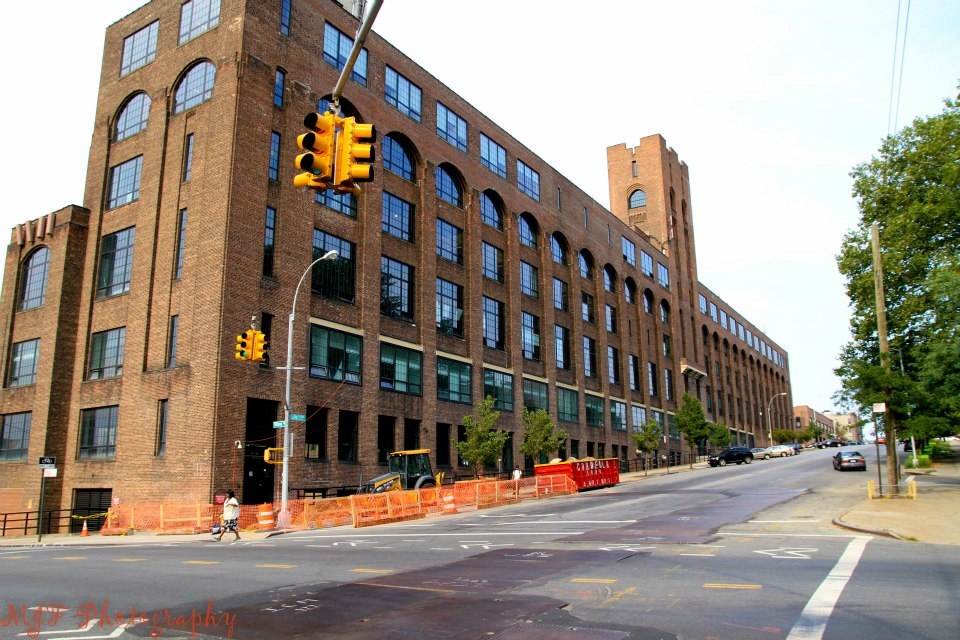
STOP 10.American Bank Note Company printing complex (built 1911) is an official NYC Landmark. Read all about it in its official designation report by clicking here. This highly productive facility once employed hundreds who worked in three consecutive shifts. Among it’s many products were South American currencies and American Express Traveler’s Checks.
Tiffany Street unfolds with great sites as we continue toward, below, and immediately on the other side of the Bruckner Expressway above head. Now, at the intersection of the Bruckner Boulevard (at street level) and Tiffany, a powerful community development group presents buildings visible on both north and south sides of the street.
STOP 11. SEBCO (South East Bronx Community Organization) was founded in 1968 and has done a great deal to improve the lives of many in the Hunts Point-Longwood neighborhoods. Much has been written about this group over the years. To your left is a low-rise health center they initiated over a decade ago. The tall senior housing facility on the right (although it faces the next block: Southern Boulevard) has the name “Sister Thomas Apartments” facing you. Housing and health are just two of their areas of action. Father Louis Gigante of St. Athanasius Church and other locals formed the South East Bronx Community Organization (SEBCO) as a community development non-profit. Many came to know SEBCO for having painted on some of the buildings they rehabilitated the words “Father Louis Gigante Rebuilding the South Bronx.” This large declaration was seen for decades from the Bruckner Expressway. Learn more by visiting their website here.
Looking just one block ahead on Tiffany Street, let’s head to the Renaissance-inspired building at 877 Southern Boulevard.
STOP 12.Hunts Point Library. This site indicates a rich man’s literacy revolution. The Andrew Carnegie endowment built libraries throughout North American and Britain. The Hunts Point Branch was the final NYC branch built under this endowment; it opened in 1928. At one time, the New York Public Library houses a substantial Latino literature department here. Today, you would find a similar specialty collection at the Bronx Library Center a few miles to the north.
This important public building is situated on Father Gigante Plaza, a pedestrian-oriented public open space framed by a gated park and fountain to the south (maintained by SEBCO), Fox Street on the west and our next attraction.
Skirt the church building, leaving the plaza, and examine its beautiful westerly windows on Fox Street. Then continue along Fox 1.5 blocks (passing Barretto St.) to 928 Fox Street.
The Casita Maria Center for Arts & Education has developed their own South Bronx Culture Trail. Their mission is to empower youth and their families by creating a culture of learning through high quality social, cultural, and educational opportunities.
They welcome kids at the age of six and stay with them until college while providing family learning through the arts. They distinguish themselves in the plurality of ways in which they attract community members to utilize their services. Their students introduce their parents to their cultural programs, while their public programs guide parents to wide ranging education programs. Founded in 1934, they have served many who have gone on to enrich the world through culture, public service, education, and business. Alumni and program providers have been many. Some highlights include:
Double back along Fox street to Father Gigante Plaza where the church we visited stands. Now walk away from the plaza along Tiffany Street so that you are seeing low-rise private homes to your left. Join E. 163rd Street two blocks away, then walk along that street to where E. 163rd and Kelly streets cross. Looking into Kelly Street, take a moment to appreciate the crescent shape of this block as well as it’s early 20th century feel.
STOP 15.Kelly Street (aka Banana Kelly) is an iconic Bronx Street.
It’s been made famous around the world by memoirs of locals including General Colin Powell who recall living and playing here.
Walk slowly down this crescent-shaped street toward the park one block ahead. Next, turn right and find 928 Intervale Avenue.
STOP 16.Mothers on the Move (MoMs) is a community organizing group. There has been good power sharing between Latinos and African-Americans here. Joyce Culler, a long-standing Bronx Community Board 2 member, is a MOMs board member. MoMs works on education, transportation and other issues. It has been led for over a decade by Wanda Salaman, a modest and highly effective Latina of African descent.
Next door is a convenience shop where you may want to grab a drink and a snack so you can enjoy a break in the park across the street.
STOP 17 (SHADE/REST/BATHROOM BREAK).Rainey Parkhas athletic fields rimmed with shaded strolling paths and benches and a comfort station. It symbolizes the Bronx rebuilt. Similar to most community gardens, it occupies land where housing stood 60 years ago. Today, it’s a park named for a major local African-American civic leader–William F. Rainey (1920-1985)–who once ran the local Police Athletic League. Once you’ve enjoyed the charms of this relatively recently renovated park, proceed to the school anchored at its southern end.
Across the street at 991 Longwood Avenue (at Beck Street) is the most recent incarnation of a longstanding children’s play/learning/health institution.
STOP 19.Police Athletic League (Longwood Center). The building you see here dates to 1996. Since 1914 PAL has been serving New York City’s youth with safe, structured programming designed to engage boys and girls in positive activities that improve their quality of life, present developmental opportunities, and offer the prospect of a brighter future. What started out as the closing of streets by the New York City Police Department to enable the city’s unsupervised youth to play became a city-wide Cops & Kids movement and later national model that brought communities and police together in ways that prevail to this day.
Cross Longwood Avenue into Beck Street. Explore the length of this block until Beck Street meets E. 156th Street.
STOP 20.Longwood Historic DistrictAccording to the Lehman College Art Gallery website, “Built at the turn of the 20th century, the Longwood Historic District is an enclave of primarily two and three story row houses constructed in anticipation of the population surge expected into the area. Real estate developer George B. Johnson purchased the old S. B. White estate on speculation and hired architect Warren C. Dickerson (also known for his work on Mott Haven Historic District structures) to design and construct houses. By the time that the IRT subway line (today’s no. 6 train) from Manhattan reached the neighborhood in 1904, Dickerson’s houses were completed and clustered nearby.” Read the complete entry by clicking here. See a simulation of the old White mansion on the SE corner of Beck Street and E. 156th Street.
Make a right on E. 156th Street. One block away is a white glazed brick building at the corner of Kelly Street.
STOP 21.Prospect Hospital (not shown) is where Irma Fleck hatched a late 1970s green business with help from a veteran of the federal War on Poverty scene. Bronx Frontier was born here. See the earlier Gardening and Garvey article to learn more about that Bronx success story. Continue along E. 156th Street for three blocks until you arrive at Prospect Avenue. Please look up at the street signs on this corner by Public School 130.
STOP 22.Dra. Evelina Antonetty Waywas unveiled in 2011. The street sign is located at the intersection of Prospect Avenue and E. 156th Street.
Take time to reflect and be empowered by thelegacy of Dr. Evelina Lopez Antonetty (1922-1984). “Titi” or “Auntie,” as she was often called, createdUnited Bronx Parents and was a force for establishing bi-lingual education locally and nationally. Among her hundreds of accomplishments, she protested, periodically shut down filming for, and got twenty jobs for local people-of-color in the filming of Fort Apache, a fictional film set in the Bronx. Her mural across the street (below) reads her words from 1980: “We will never stop struggling here in the Bronx, even though they’ve destroyed it around us. We would pitch tents if we have to rather than move from here. We would fight back, there is nothing we would not do. They will never take us away from here. I feel very much a part of this and I’m never going to leave. And, after me, my children will be here to carry on…I have very strong children…and very strong grandchildren.”
Titi’s daughter Anita Antonetty once provided career counseling services to the youths of Rocking the Boat in Hunts Point. Many were pleasantly surprised to encounter a mature Latina deeply aware of Bronx ecology issues and trends. Anita continues to make her mark on the Bronx sustainability front through community boards and beyond.
Our final destination for today’s tour is across from the nearest train station. Please make a right on Prospect Avenue and walk toward the very visible train tracks above Westchester Avenue in the near distance. Just before you reach this refurbished and remodeled Victorian Revival-styled train station, you’ll see 786 Prospect Avenue. You have arrived!
CONCLUSION: Casa Amadeo is regarded as a national landmark. It’s a music store specializing in Afro-caribbean sounds. You can even buy musical instruments there. If you’re lucky, you may visit when a spontaneous jam session is happening live in the back room. The owner, Mike Amadeo, is a musician and composer who is well known in traditional Latin music circles. The elegant Old Bronx building they occupy once houses both Tito Puente and Celia Cruz.
Thank you for walking with us! Bronx River Sankofa invites you to always move forward strengthened by the wisdom of reflecting periodically!
===================================
A Hunts Point Walk: Part 2
You are invited to trace the steps of a few dozen young Americans (ages 16-38) who have walked their neighborhood. American history expresses itself in stone and paint, plants and asphalt as you will see. Enjoy these points of interest:
1. Hunts Point Riverside Park
2. Bright Temple A.M.E. Church
3. Engine 94, a beautiful fire house
4. Bryant Hill Community Garden & Old NY Townhouses
5. Garrison Park (once envisioned as a sculpture park for the Bronx River)
6. South Bronx Greenway
7. Ruby Bridges Mural by Sharon De La Cruz
This article is dedicated to two active citizens in the Hunts Point community: Cybeale Ross has been a Hunts Point home owner since 1957. She has marched with Mothers on the Move for improved schools, traffic-calming street enhancements, and more over the last several decades. Paul Lipson helped establish The Point community center in the early 1990s after earlier success with Bronx Frontier, a local and popular green business.
Cybeale Ross and Paul LipsonHunts Point Riverside Park
Begin at Hunts Point Riverside Park now enjoyed in its second and most recent phase. This waterfront park at the base of Lafayette Avenue was established in the 1990s through many hands after an executive at The Point (a younger Majora Carter) was forced to spend a moment at this former dead end street following her dog’s independent spirit. The original park had several magical weeping willows and a simple boat launch. The professionally designed green patch you see today opened around 2006. It has garnered national attention and won the Rudy Bruner Award for excellence in the urban environment. Next door is The Point’s Campus for Arts and the Environment as well asRocking the Boat.
Walk up the hill along Lafayette Avenue to its intersection with Faile Street, named for a wealthy nineteenth century resident according to John McNamara’s History in Asphalt: the origin of Bronx Street and Place Names. You’ll notice as you go many younger trees planted in the public right-of-way along curbs, on side streets and even with relatively new traffic medians. Hunts Point has had several waves of urban forestry enhancement since the 1980s, especially since the late 1990s. This short walk takes you past the successful product of three distinct tree planting campaigns!
On your right is Bright Temple AME Church. This stone neo-Gothic former single-family mansion was built circa 1860 by a family that manufactured printing presses–including for the New York Times in the 1800s. This building is a great place to consider ethnic succession within Hunts Point. An English-descended family, whose land extended down to the nearby Bronx River, was the first to occupy it. Some time after the contents of the house were auctioned off following the death of that family’s patriarch, a Jewish Synagogue was established (1919). In the post-World War II period, Bright Temple AME Church assumed ownership to serve the expanding African-American population. Skirt Faile Street to see each side of this richly ornamented building. The church photo you see above was taken around 2005 for Bronx River Sankofa’s founder by the late great photographer and musician Ibrahim Gonzalez.
Without crossing the street, continue along Faile Street until you reach Seneca Avenue. As you approach this corner, look at the Renaissance-inspired fire department building from the “roaring twenties” on your left.Engine 94‘s open-air third floor facing Seneca Ave. combined with light-colored terra-cotta decorations contract handsomely with red brick to evoke Old Italy.
Now turn toward the industrial border of Hunts Point and walk one block along Seneca Avenue to Bryant Avenue. John McNamara’s book reports that, “Its proximity to streets dedicated to American poets Longfellow, Whittier, and Drake would seem to be reason enough to honor William Cullen Bryant.” Once at the corner of Seneca and Bryant, turn left and walk half-way into the block passing the first open lot inhabited by rabbits and chickens. Several steps ahead, you will see a community garden on your left unusual in its abundance of trees. You’ve arrived at Bryant Hill Community Garden. Taino Indian traditions live here under the guidance of local gardener Lucia Hernandez whose circle have succeeded the first generation of gardeners who preserved this oasis at least one generation ago. Hunts Point was largely a walk-to-work district 100 years ago when it was sometimes called “Little Pittsburgh” owing to its abundance of light and heavy industry. Notice the brightly colored and richly ornamented townhouses across the street from the garden where earlier generations lived. At that time, German was the Bronx’s second most common language.
Next we’ll see what may yet become Garrison Sculpture Park. Continue along Bryant Avenue to the corner where it meets Garrison Avenue, then cross the street–while walking in the same direction–and look down-hill along Garrison. Standing at this intersection of Garrison and Bryant avenues, you’ll notice a shabby patch of green with moderately tall trees just a few blocks away where land meets water. Don’t be fooled by the residential tower in the visible distance; that’s the neighborhood of Soundview across the Bronx River. While this park-in-progress has long since been declared official city land, no effort to improve it has been completed. Many times, this waterfront site has been cleaned, composted, planted and re-designed. Of the formal designs, including one by Pratt for a riverside amphitheater, none have substantially transformed the site and made it a destination for recreation seekers. Over thirty years of planning and false starts have passed in the process. Bronx River Restoration Project Incorporated (founded in 1974), predecessor of the Bronx River Alliance (founded in 2001), first envisioned a park here at the end of the 1970s.
In 2003, Alcoa Corp. proposed partial financing for a sculpture park here following on schematic drawings complete with an amphitheater developed by an out of state college.
Turn and walk in the opposite direction along Garrison Avenue to the busy commercial street with shops in the near distance. That’s Hunts Point Avenue. Find 889 Hunts Point Avenue across the street. It’s a great location from which to appreciate the emerging South Bronx Greenway. Check it out! You are surrounded by the following relatively new amenities funded by your federal tax dollars (2009 American Recovery and Reinvestment Act): uniform tree guards, public benches, many new trees (the ones with small trunk diameters planted off the sidewalk), permeable pavements via Belgian blocked walkways curbside, new stylized lighting fixtures, and richly planted in-street medians.
Sharon De La Cruz and the Urban Art Program of NYC’s Department of Transportationprovide us with our final stop, Ruby Walks (Walking Series). Please turn toward the busy Bruckner Expressway whizzing above street level one block away and walk toward it along Hunts Point Avenue. If you’re walking this tour in 2014 or 2015, you’ll see Sharon’s group of paintings depicting a girl in multiples clasped to the wall of the bridge over the train tracks (between Garrison Avenue and Bruckner) here. Read all about it in DNAinfo, theHunts Point Express and/ or Nilka Martell’s piece in the Bronx Free Press.
And this concludes Morgan Powell’s final tour which he published.
Baron Ambrosia enjoys a nice home brewed beer after swimming the entire length of Camden’s Cooper River. / Photo Credit: Christopher Beauchamp Photography
Baron Ambrosia has swum yet another river against all odds.
With a Forbidden Swim, Shining a Light on a City’s Verdant Waterways – NYTimes.com
CAMDEN, N.J. — At 5:48 a.m. on Wednesday, under the half-light of an eclipsed moon, a Bronx man known as Baron Ambrosia slipped into the Cooper River here. Wearing a short wetsuit and goggles, he began doing a freestyle stroke in the murky water. “Ooh, just touched something really gooey,” he said, coming to a sudden halt.
So began one man’s quest to paddle through Camden, known more for its high crime rate than its verdant waterways. With his five-mile swim along the Cooper, a tributary of the Delaware River, Baron Ambrosia aimed to change that.
“I’m trying to do something good for the city,” he said, highlighting urban exploration and environmental renewal. Born Justin Fornal, he has made a career of celebrating the gritty, most prominently as his alter-ego Baron, a fancifully attired Bronx foodhound with his own eccentric cable series (recently spotlighted by Anthony Bourdain on his CNN show). Last year, Mr. Fornal, 36, swam the Bronx River to promote his home borough, the first person recorded to do so. This year, asked by friends where he might take another dip, he settled on Camden as a similarly unsung landscape.
WalkNYC Pedestrian sign at 149th Street and Grand Concourse.
WalkNYC street signs have finally landed in The Bronx providing residents, employees and visitors of the Melrose and Mott Haven area with a map to the immediate area. The signs, which debuted last year in Chinatown, Herald Square/34th Street, Long Island City and Prospect Heights and Crown Heights, provide pedestrians with a wealth of information, including average walking distance to various landmarks and subway stations.
New York City is known for its walkability and this is DOT’s way of making it even easier to get around and encourage folks to do more walking or using mass transit by way of these signs.
“WalkNYC is New York City’s standard for pedestrian wayfinding. WalkNYC provides a clear visual language and graphic standards that can be universally understood, encourages walking and transit usage by providing quality multi-modal information, and provides consistent information across a broad range of environments in the city.
WalkNYC signs provide valuable information, from basic cardinal directions and street names to mapped details like subway entrances and Wi-Fi hotspots. The maps are rotated “heads-up” or forward-facing to show the street network as it appears in front of you. Research and user testing demonstrate that this method is more accessible for people who are unfamiliar with their surroundings or have trouble reading maps.”
Also installed is a sign at the 149th Street Grand Concourse 2/4/5 station announcing the Grand Concourse Historic District which beckons riders, as they exit the station, to “Explore New York State’s Path Through History.”
Sign in Melrose in front of Lincoln Hospital at 149th Street and Morris Avenue. The signs provide all sorts of information, a clear map of the area as well as walking times to key destinations.One of the maps at the 149th Street/Grand Concourse WalkNYC Sign. Each sign displays 4 maps. Two showing a radius of 15 minutes walking distance and two showing 5-7 minute radius walking distance.How long will it take to walk to Yankee Stadium?Can you tell me how to get to Melrose?
What do you think about the signs? Would you like to see more of these throughout the neighborhood and the rest of The Bronx? Do you think you’d be encouraged to walk more using these guideposts and knowing how long it would take you to get to your destination? Let us know what you think!
Site F of the Mott Haven-Port Morris Waterfront Plan: Historic Port Morris Gantries -stands as a reminder of NYC’s rich nautical heritage; in 1902, the gantries fostered the development of a market, hotels and restaurants; recognized by the Historic Districts Council during its “Six to Celebrate” program on the basis of architectural and historic merit of the area; full reviatlization renderings have already been completed
Supreme Court Justice Sonia Sotomayor is not as reserved as her fellow justices, a biographer says. / US News & World Report
From US News & World Report:
America may have its first celebrity Supreme Court justice, author Joan Biskupic says.
It was fairly early in the writing process when author Joan Biskupic, the biographer of Supreme Court Justices Sandra Day O’Connor and Antonin Scalia, heard about Justice Sonia Sotomayor and “the salsa incident.”
As the story goes, it was June 2010 and the Supreme Court justices and their law clerks were celebrating the end of term with the clerks performing skits for their bosses. For Sotomayor, who had joined the high court in August 2009, it was the first of such occasions. “Here’s what you should know: By tradition, the clerks perform, the justices watch,” Biskupic explains to Whispers.
But that year, after the law clerks were done with their skits, Sotomayor “sprang from her chair, turned to the law clerks and declared that although their musical numbers were all fine enough, they lacked a certain something,” Biskupic writes.
She then demonstrated what they missed. “She cues the salsa music – at first she grabs a few of her law clerks who clearly had been in on it with her,” Biskupic says. She eventually got Chief Justice John Roberts on his feet, signaling this was socially acceptable to the remaining, seated justices. “[Roberts] was a good sport. He was an anxious sport, but he was a good sport, and then she gets the others to go,” Biskupic says.
The whole incident led to Scalia (the life of a party in his own right, according to Biskupic) joking, “I knew she’d be trouble,” as people passed him near the door.
Candidate for NYS Attorney General Files Complaint With JCOPE About FreshDirect Lobbying
Contact Ramon J. Jimenez 917 517 1320 Also Available for Spanish Language Interviews
Complaint focuses on failure to disclose lobbying by firm paid tens of thousands of dollars
In response to the recent revelations about The Parkside Group apparent lobbying of the NYC Mayor’s office on behalf of trucking company Fresh Direct, Green Party candidate for NYS Attorney General Ramon J. Jimenez today filed a complaint with the New York State Joint Commission on Public Ethics.
As demonstrated in the complaint, The Parkside Group has apparently engaged in lobbying activity in New York State on behalf of an effort to obtain tax subsidies, cash grants and living wage law provisions for the trucking company Fresh Direct, but the lobbying firm seems not to have disclosed the full extent of its activity as required by the Lobbying Act.
In 2012, without any open discussion, Fresh Direct was offered a controversial package of public subsidies that include cash grants, tax breaks and asset acquisition for the potential relocation to publicly owned land on New York State Department of Transportation property that amounts to over $140 million at this point, without a current environment impact statement.
“While on the campaign trail DeBlasio used the Bloomberg era FreshDirect subsidy proposal as an example of what his Administration would NOT do. Over nine months in office and he has yet to kill this rotten deal. Leaked emails between Parkside and the Deputy Mayor show communications about millions of dollars in potential cash grants and tax break subsidies have not been reported in the mandated bimonthly JCOPE disclosure forms. The public deserves to have the legally mandated information to understand what pressure is brought to bear on our elected officials and inform open debate. As Attorney General I will vigorously investigate and prosecute ethics violations and bring more transparency to our government.” says Ramon J. Jimenez.
Fresh Direct has so far evaded having to comply with the Fair Wages for New Yorkers Act and the recent Mayoral Executive Order that further mandates employers that are considered for $1 million or more in public subsidies to pay a Living Wage. Fresh Direct is under consideration for nearly $90 million in City support and the Living Wage mandate has not been publicly affirmed despite hundreds of their workers making less than $9 an hour. “As Attorney General of the State of New York I will work to hold companies accountable to all City and State Living Wage legislation and procurement rules and no lobbyist will be able to secretly negotiate deals to avoid it.” added Ramon J. Jimenez.
“The environmental impact of thousands of diesel truck trips in the South Bronx an area with one of the highest rates of asthma in the nation would be catastrophic. It is unconscionable that a proposal of this magnitude was not required to have a current and accurate Environmental Impact Statement. We do not know what role any backroom lobbyists played in that decision either. There needs to be a reset on this whole proposal and the South Bronx community must be included in future planning for the waterfront, which is owned by the State of New York and has for too long served as the dumping ground for the polluting facilities that benefit the rest of NYC.” Ramon J. Jimenez added.
Ramon Jimenez is a longtime Bronx based lawyer, community activist and writer. For more than 30 years, he’s represented low income families, injured workers and community groups in the poorest Congressional District in the U.S.
He earned his law degree from Harvard School of Law in 1974. As a professor at Hostos Community College in the Bronx in 1976, Ramon led students, faculty members and others in a demonstration and occupation of the college in protest of plans to shut the school or merge it with another college. The protest was successful and Hostos saved. In the ’80s, Ramon served as an administrative law judge for the State Workers Compensation Board.
More about him here: http://ramonjjimenez.wordpress.com
This is an amazing big step forward for the residents of the South Bronx as never before has this area received such a priority designation by the State of New York. The waterfront plan as described below is a direct result of what the residents envision their waterfront to look like after the announcement over 2 1/2 years ago that FreshDirect intended to plop down on the last, largest remaining parcel of open land in the area.
Together, our voices can make an impact and be heard.
Please submit your public comments and make your voices heard even louder!
See below from South Bronx Unite, an organization which Welcome2TheBronx is a proud member of.
NEW YORK STATE PROPOSES PRIORITIZATION OF MOTT HAVEN-PORT MORRIS WATERFRONT PLAN!
A: Bronx Kill Waterfront Park – site of Native American settlement and burial ground; last significant open green space on the Mott Haven-Port Morris waterfront; lines the Bronx Kill waterway; directly connects to the“Randall’s Island Connector”
B: Park Avenue Boat Launch and Waterfront Park –already green space; one of the few areas with actual water access not blocked by Oak Point Link rail; already being used as an ad hoc fishing and boat launch site
C: Lincoln Avenue Waterfront Park – easily accessible by pedestrians; already being used as an ad hoc fishing site; provides direct access to the waterfront; renderings have already been prepared by local architects; MIT produced a plan for this site in 2011
D: Alexander Avenue Extension of Lincoln Avenue Waterfront Park– easily accessible by pedestrians; vacant and unused site; community blocked by fence and guard; directly connected to Mott Haven antique district
E: East 132nd Street Pier – previously a pier here (and even a floating pool in 1902); in the 1980s, a ConEd explosion destroyed the pier, and the company never replaced it; currently residents crawling through holes in the fence to fish along the banks of the shore
F: Historic Port Morris Gantries -stands as a reminder of NYC’s rich nautical heritage; in 1902, the gantries fostered the development of a market, hotels and restaurants; recognized by the Historic Districts Council during its “Six to Celebrate” program on the basis of architectural and historic merit of the area; full reviatlization renderings have already been completed
G: Mott Haven-Port Morris Waterfront Connecting Path– connecting West to East – Melrose to Hunts Point – the waterfront connecting path would weave through and around existing uses on the waterfront to connect the six interrelated projects, and also connecting to the “Randall’s Island Connector” near completion now
The Mott Haven-Port Morris Waterfront Plan was voted by overwhelming majority for inclusion on the draft list of priority projects of the New York State Department of Environmental Conservation (DEC) Open Space Plan! Never before has our community had a priority project in the plan! The Open Space Plan serves as a blueprint for the state’s land conservation efforts, identifying priority open space projects for protection and guiding State Environmental Protection Fund investments. From now through December 17th, the public is being asked to provide comments on the plan via email. On October 22, a public hearing will also be held from 2:30-4:30 and from 7:00-9:00 at 47-40 21st Street, Long Island City. After the public comment period is closed, DEC will review all comments on the proposed plan and issue a final plan of priority projects.
IF THE LINKS DO NOT WORK, SEND YOUR COMMENTS THIS WAY: TO:LF.OpenSpacePlan@dec.ny.gov CC:southbronxunite@gmail.com SUBJECT: I support the Mott Haven-Port Morris Waterfront Plan as a Priority Project for Region 2! MESSAGE (draft): To Whom It May Concern:
I support inclusion of the Mott Haven-Port Morris Waterfront Plan as a priority project for the New York State Department of Environmental Conservation Open Space Plan. This community-developed plan would provide underserved residents access to a public waterfront that, for decades, has been inaccessible. The plan is consistent with three rezonings on adjacent land, provides a logical solution to climate change effects on significant maritime industrial areas (SMIAs) and gives the community open space to counteract severe health consequences caused by an oversaturation of highways and truck-intensive businesses in the South Bronx. These vacant coastal sites are located within a flood zone, and if properly designated as protected open space, could significantly mitigate dangerous effects on the community of storm surge flooding of existing power plants and waste transfer stations along the South Bronx waterfront. Each site has also been included as an area of significance in the Vision 2020 NYC Comprehensive Waterfront Plan, and several sites are currently proposed for elimination from SMIA designation. These sites, all of which are government owned, are easily accessible by pedestrians, have recognized historical significance, are already being used as ad hoc fishing and canoeing sites and connect to bigger capital projects already funded and under development (like the Randall’s Island Connector).
Sincerely,
The loss to our borough is incalculable. The knowledge that Powell not only possessed but made sure to SHARE with the community made him one of the most important historians of our beautiful borough.
I first met Morgan back in April 2011 when Landmarks Commission began the discussion to create the Grand Concourse Historic District. Since then we always remained in touch and our paths would cross many times through the course of our activism, including contributing to Welcome2TheBronx.
“When we started the Bronx African American History Project in the Spring of 2003, one of its most enthusiastic supporters was a young man named Morgan Powell who was a professional gardener and had a passionate feeling about Bronx communities and the people who lived in them. Not only did he feel that the contributions of Black people in the Bronx had been neglected, he was committed to making the great network of waterways that ran through and surrounded the Bronx more accessible to its residents. Morgan not only helped us recruit interviews for our project, he began doing pioneering research on his own on the history of the Bronx River and its impact on adjoining communities, particularly residents of color. His research took him back into colonial times and before long, Morgan had actually developed a series of walking tours that had the twin purpose of teaching people about this history and turning them into advocates for conservation of waterways and green spaces. His tours and lectures became among the most sought after events publicizing Black History in the Bronx. But what was so amazing is how he did this incredible research without grants, and offered his tours free of charge. It is hard to think of another person who gave so much to our communities with such brilliance and generosity of spirit. Not only that, but Morgan donated all of his research materials to the Bronx African American History Project so future generations of scholars, as well as current researchers would have access to them. What he did for our project, and for the people of the Bronx is wonderful, awe-inspiring and quite frankly history making.
I cannot put in words how devastated I am by his death. Morgan was warm, funny, generous, ironic, entertaining. He lit up any room he was in. He set an example of passion for knowledge and generosity of spirit that, in my lifetime, I have rarely seen equaled and and rarely surpassed. RIP My Brother. I Love You. And will miss you terribly”
Many of us who knew him, for whatever length of time, know Dr. Naison’s words to be true.
On one of his last postings on Facebook, Morgan said, “For anyone wondering why I post so little on Facebook, know that I am committed to enjoying sunshine! If I’ve neglected our friendship or you need me somehow, just e-mail me and let’s get together in the real (opposed to the digital) world. Concourse.vision@gmail.com is our portal to good times. “Sunshine almost always makes me high…”
IF YOU KNOW OF ANY LIVING RELATIVES OF MORGAN POWELL, PLEASE CONTACT IMMEDIATELY AT info@welcome2thebronx.com
RIP, Morgan, know that you were a true, Bronx Hero and we lost a little bit of our light. This one’s for you:
In anticipation of the album, he’s launched the video for his song, ‘Goodlife’ and it’s definitely a keeper. Filmed entirely in The Bronx — in Co-op City to be exact — the video is a fun, upbeat, and playful montage of Estrada just being himself and having fun.
One of my favorite lines from the song is when he sings (and the last line is true for many Bronxites!):
“And throughout the day, remember your lonely nights, remember your darkness… Remember it all your life. Don’t ever forget where you come from.”
So what are you waiting for, check out the video and share it with your friends, family and networks and help support this local Bronx artist!
New York City Department of City Planning recently made headlines with the announcement of the Cromwell-Jerome Study Area that straddles the Bronx neighborhoods of Highbridge, University Heights, Morris Heights, Mount Hope, and the Concourse. The study encompasses a massive 57 block corridor with Jerome Avenue as its spine.
According to an update from City Planning:
“The first Cromwell-Jerome Planning Group meeting was held on September 30, 2014, at Bronx-Lebanon Hospital. More than thirty residents, stakeholders, local elected officials and community-based organizations brainstormed on the Cromwell-Jerome Neighborhood study, key topics that should be addressed, roles for City agencies, and best ways to engage the broader community.
Upcoming Events: DCP invites the public to join Community Walking Tours of the study area. The first tour is scheduled for Saturday, October 18th from 11AM-12PM and will provide a general overview of the study area. The second tour is scheduled for Saturday, October 25th from 11AM-12PM and will focus on transportation and parks in and around the study area. The tours will begin at the NW corner of the Grand Concourse and East 167th Street in front of the High Life Deli and Grocery.
Please check the webpage regularly for updates on the study and upcoming events.
For more information on the Cromwell-Jerome Neighborhood study, contact the Bronx Office of the Department of City Planning at 718.220.8500.”
That being said, it is EXTREMELY IMPORTANT for residents of the neighborhood to participate in these meetings and walking tours so that the community can voice what they want to happen (or not happen) in the very neighborhoods they live in.
In support of Mayor de Blasio’s Housing New York Plan, the Department of City Planning (DCP) proposes to lead a ground-up neighborhood planning study to revitalize the area surrounding Cromwell and Jerome avenues in the Bronx. DCP and sister agencies will engage residents, businesses, and other stakeholders to strengthen established residential neighborhoods, promote new housing opportunities for residents at all income levels, and increase economic opportunity through the creation of a community-driven neighborhood plan centered on affordable housing in Community District 4 and Community District 5 in the Bronx. The 73-block Cromwell-Jerome area is strategically located adjacent to the Cross Bronx Expressway, west of the Grand Concourse, and spans Jerome Avenue from East 184th Street in the north to McClellan St/East 167th Street to the south. The area is surrounded by the strong residential communities of Highbridge, Mount Eden, Concourse, Mount Hope, and Morris Heights.Many community stakeholders have suggested that the Cromwell-Jerome area should be revitalized to meet existing area needs and plan for the future. Through the planning process, City Planning will seek to address the needs of local residents, businesses, and institutions. It will evaluate and identify opportunities to promote a range of elements to support community vitality: affordable housing, job growth and training, economic development, cultural activities, pedestrian safety, parks, schools and daycare, retail and services. The study will promote coordinated investments in infrastructure and services to shape a resilient, sustainable community. The study will result in a plan for land use and zoning changes, including the application of a mandatory Inclusionary Housing program within the area.
Neighborhood Profile
The neighborhood study provides a tremendous opportunity to build on the area’s many assets to support the needs of residents and businesses and develop strategies to address its challenges. The study area is well served by mass transit with six stations on the elevated 4 train; the B/D train runs along the Grand Concourse three blocks to the east, and several bus lines that provide connections to other parts of the Bronx and Manhattan. Parts of the area experience congestion and lack pedestrian amenities such as adequate sidewalks, street trees, and benches.
Step street at E. 176 Street and Jerome Avenue
The study area is developed primarily with low-scale commercial, industrial, and auto-related uses, but it also includes more than 5,000 residential units. Almost a hundred years ago, the heart of the Cromwell-Jerome area was developed as a service district to provide parking and other services to the dense residential communities that surround the area, and today includes a high number of parking facilities and auto-related uses. In most of the study area, existing zoning allows heavy commercial and light industrial uses and does not permit residential development. The Cromwell-Jerome area disconnects the residential neighborhood of Highbridge to the west from local services/retail and transit access to the east.
East 167th Street, East 170th Street, Mount Eden Ave, Edward L. Grant Highway, Tremont Avenue, and Burnside Avenue are vibrant local retail corridors in the area. More than 80% of the housing stock in the surrounding area was constructed prior to 1950 and is comprised mostly of 6-8 story apartment buildings. Vacancy rates in the area are significantly lower than the Bronx and NYC as a whole.
The 44th Police Precinct is located at E. 168th Street and Jerome Avenue. New schools recently developed in the area include the New Settlement Community Campus and the Morris Heights Educational Complex. Two charter schools are located in the area. The Cromwell-Jerome area has several small pocket parks and playgrounds that are well utilized; Mullaly Park, located to the south of the study area, is the largest park within walking distance. Bronx Museum of the Arts, Bronx Lebanon Hospital, and Bronx Community College are located just outside the study area.
Jerome Avenue – low-scale industrial and auto-related uses
Elevated view at 175th Street
E. Clark Place and Jerome Avenue
Open Parking at 170 Street
New School and Community Facility on Goble Place
Keltch Park at Jerome Avenue and E. 170 Street
Jerome Avenue and E. 170 Street
Coordinated Planning
As part of the city’s commitment to coordinated neighborhood planning, DCP and numerous City agencies will work collaboratively with the community to identify neighborhood needs and opportunities for investments that will support the long-term growth and sustainability of the area. There will be a concerted effort to align capital investments with the goals and objectives set forth as part of the neighborhood planning process. Among the City agencies DCP will partner with on the neighborhood plan are the Department of Housing Preservation and Development (HPD), Department of Small Business Services (SBS), Department of Parks and Recreation (DPR), School Construction Authority (SCA), NYC Economic Development Corporation (EDC), and the Mayor’s Office of Environmental Remediation (MOER). In addition, as part of the neighborhood study, DCP’s Transportation Division and Bronx Office have initiated a transportation study of the area. The purpose of this study is to identify existing problematic locations in terms of traffic and transportation, and identify circulation, mobility, safety and access improvements for all roadway users, with an emphasis on pedestrian safety and walkability. Recommendations for improvements will be intended to serve the existing community as well as future needs. The transportation recommendations will be developed in consultation with local stakeholders, and in partnership with the New York City Department of Transportation (CDOT).
Community Engagement
Community engagement will play a pivotal role in the creation and implementation of the neighborhood study. DCP intends for the neighborhood study to reflect the community’s vision for the neighborhood, and the agency will strive for local ownership of the study’s goals and vision in partnership with city agencies.With assistance from the Cromwell-Jerome Planning Group (CJPG), established for the purpose of advising the agencies on the study, DCP will lead a wide range of events and activities throughout the process to facilitate public participation and engage the community in the visioning process including: walking tours, visioning sessions, surveys, small group discussions, and focus groups. The Planning Group includes Community Board 4, Community Board 5, Bronx Borough President Ruben Diaz, Jr., CM Vanessa Gibson, CM Fernando Cabrera, WHEDCO, New Settlement Houses, Highbridge Community Development Corporation, Mount Hope Housing, Bronx-Lebanon Hospital, and others. The Planning Group was launched in September 2014.Update:
The first Cromwell-Jerome Planning Group meeting was held on September 30, 2014, at Bronx-Lebanon Hospital. More than thirty residents, stakeholders, local elected officials and community-based organizations brainstormed on the Cromwell-Jerome Neighborhood study, key topics that should be addressed, roles for City agencies, and best ways to engage the broader community.
Member of the Cromwell-Jerome Planning Group review the group’s mission and discuss ground rules.
Planning group member Tom Herrera discusses assets and challenges related to transportation in the study area.
Upcoming Events:
DCP invites the public to join Community Walking Tours of the study area. The first tour is scheduled for Saturday, October 18th from 11AM-12PM and will provide a general overview of the study area. The second tour is scheduled for Saturday, October 25th from 11AM-12PM and will focus on transportation and parks in and around the study area. The tours will begin at the NW corner of the Grand Concourse and East 167th Street in front of the High Life Deli and Grocery.
Please check the webpage regularly for updates on the study and upcoming events.
For more information on the Cromwell-Jerome Neighborhood study, contact the Bronx Office of the Department of City Planning at 718.220.8500.
From our friends at The Bronx Artist Documentary Project:
Artist King Bee photographed for the Bronx Artist Documentary Project by Brian Nobili
Imagine a book
filled with beautiful photographs
taken by Bronx photographers
depicting Bronx artists
at work — right now — right here in the Bronx!
The Bronx Artist Documentary Project exhibition (100 photographs on view now at the Andrew Freedman Home) deserves to live on for eternity in a beautiful, hardcover, full-color, coffee-table book — a testament to the creative cauldron that is The Bronx today!
YOU CAN HELP MAKE HISTORY! Donate to our KICKSTARTER CAMPAIGN so that this book becomes a reality!
Pre-order your copy (what a great gift)! Tell your friends– Tweet it –Post it!
This is an entirely Bronx-based project — show us the love and support the arts and artists of the Bronx!
We’ve raised 33% of our goal, with only days left of the Campaign. You can make a difference — pledges start at just $1.00. Everyone who donates will receive acknowledgment in the book, plus there are many other unique rewards.



 Tanya Fields