Come over to the Bronx Documentary Center today from 4-7PM to see the works of the Bronx Junior Photo League, a group of students from Immaculate Conception School in Melrose.
The 6th-8th grade students have been working hard all year-long with the BDC’s staff and volunteers in learning photography and how to document your own neighborhood in the hopes of creating future journalists from within our own communities.
BDC volunteers, Melissa Bunni Elian and Groana Melendez guide a Bronx Junior Photo League member as she edits her work.
Last year’s exhibition was quite impressive and we’re looking forward to see what this year’s class has developed (pun very much intended).
The exhibition is on view from today, Thursday, May 14th through Sunday, May 17th.
Check out our pictures from last year’s exhibition!
The BDC is located at 614 Courtlandt Avenue at the corner of E 151st Street:
Yesterday, we were treated to a special media preview for The New York Botanical Garden’s ‘Frida Kahlo: Art-Garden-Life’ exhibition—after 11 months of its announcement—and all that anticipation and build up was well worth the wait.
Immediately upon entering the main gates at Southern Boulevard aka Dr. Theodore Kazimiroff Boulevard, you see a row of tall palm trees in planters and traditional Mexican folk music playing through the speakers.
One of the first things you’ll notice is the addition of a cantina created just for the exhibition where you can purchase a tasty agua de jamaica or hibiscus punch or even an horchata (the Mexican version is made of rice milk with sometimes a hint of vanilla but always has cinnamon thrown in).
A video posted by Ed García Conde (@welcome2thebronx) on
As you walk towards the Enid A. Haupt Conservatory, where Kahlo’s reimagined studio at La Casa Azul aka the Blue House is on display, one is treated to poems (everything about this exhibition is bilingual in English and Spanish) as part of the Poetry For Every Season: Octavio Paz Poetry Walk. Octavio Paz, a Mexican Nobel Prize winning author and poet, wrote poems referencing many native plants and flowers hence their inclusion as part of this multidisciplinary artistic display on Kahlo’s life and influences as well as her art. The exhibition wing at the conservatory is an explosion of the native fauna of Mexico found at Frida Kahlo and Diego Rivera’s Casa Azul including typical pottery and planters (speaking of pottery and planters, don’t forget to check out the gift shop which is filled with Frida related items.) La Casa Azul was painstakingly recreated down to getting the right blue pigment. It was a project that was years in planning to get it just right and it is the first of its kind that examines Kahlo’s, “…interest in the botanical world” as the NYBG tells it. The New York Botanical Garden explains: “When we began to research Frida Kahlo, we wanted to delve into the story of the woman who has been examined through her pain and suffering and paint her in a different light. We wanted to learn more about the iconic face that is emblazoned on canvases, the strong and fierce-looking dark-haired, dark-eyed woman who used to be known as Diego Rivera’s wife and is now known simply as Frida. The more we researched, the more intrigued we became. To us, Self-Portrait with Thorn Necklace and Hummingbird was an image of a woman immersed in tropical flora. Her still-life paintings, an important yet lesser-known portion of her work, are informative displays of the rich diversity of Mexico’s plant life. We were fascinated by the incredible detail of Kahlo’s curated life, as evidenced by her paintings, her letters, and archival photos of Kahlo and Rivera in their garden. Her story was ripe to be told by The New York Botanical Garden.
First and foremost, we surmised that Kahlo possessed a keen appreciation of the beauty and variety of Mexico’s flora and fauna, an interest evident in the garden and decoration of her home, the Casa Azul, as well as in the complex use of plant imagery in her painting. We aimed to achieve a new understanding of her paintings by looking at them through a horticultural lens. Kahlo’s nationalistic leanings seem to have contributed to her interest in tropical and desert plants, many native to Mexico. And the collector’s drive that fueled her stunning collections of toys and art seems to have extended to her garden, which evolved over time to include a wide array of plants.” After you’re done at the conservatory, make sure to head over to the 6th floor of the LuEsther T. Mertz Library—one of the most comprehensive and biggest botanical libraries in the globe— to continue the exhibition where 14 of Frida Kahlo’s works are on display including paintings and drawings.
“I paint self-portraits because I am so often alone, I am the person I know best.” — Frida Kahlo
Many of these are not as widely known as some of her other works but their importance isn’t diminished by that fact but in rather offer a greater insight into the Frida because of their relative obscurity due to many being borrowed from private collections.
Artist Humberto Spindola looks on as two male models pose wearing replicas of his paper dresses based on Frida’s ‘Las Dos Fridas/The Two Fridas’. The use of the male models is an allusion to Kahlo’s bisexuality and she often dressed in drag as even posing in family portraits as a man.Frida Kahlo in drag, with sisters Adriana and Christina and cousins Carmen and Carlos Verasa, photographed by Guillermo Kahlo, 1926.
On the 4th floor of the library, you will find a representation of one of Frida’s works, ‘Las dos Fridas’ (The Two Fridas) recreated as paper dresses in a traditional 17th and 18th century Mexican style that quite possibly dates back to the ancient Aztecs. Artist Humberto Spíndola of Mexico created these in 2009 and had two male models wear the dresses which he did once again for the preview yesterday. This is just a mere fraction of what to expect at Frida Kahlo: Art-Garden-Life as the exhibition runs through November and is chock full of programming from music concerts, dancing to lectures and film (See NYBG for more information on the following: Frida Kahlo |Evenings |Calendar |VisitGet Tickets | Ongoing Programs | Educational Events | Weekend Celebrations | For FamiliesFor Members | Calendar | Coming this Fall )
The exhibition opens to the general public this Saturday, May 16th, however, NYBG members get to enjoy the exhibition on Friday, May 15th and information is as follows: Friday, May 15; 10 a.m.–8 p.m. Members have exclusive access to this blockbuster exhibition and special programs before the public opening. Benefits on Members-Only Preview Day: • Free parking with a valid Member ID • 20% discount on all purchases at Shop in the Garden • 10% discount at the Café • Up to four half-price tickets for friends and family Guest passes are accepted with valid Member ID. Don’t forget to tag your pics on social media using #FridaNYBG and tag us #welcome2thebronx so we can see them!! Let us know what you think when you see it! Oh and don’t forget, you can take the mobile tour via your smartphone! The mobile website is a digital brochure and map of the exhibition right on your phone and you can even take a selfie and dress it up Frida style. The content is available in both English and Spanish!
Artist Humberto Spindola looks on as two male models pose wearing replicas of his paper dresses based on Frida’s ‘Las Dos Fridas/The Two Fridas’. The use of the male models is an allusion to Kahlo’s bisexuality and she often dressed in drag as even posing in family portraits as a man.
Artists in Residency, The Villalobos Brothers will be performing at the garden several times during the course of the exhibition.
Recreation of Frida’s desk inside the Enid A. Haupt Conservatory
La Casa Azul
La Casa Azul Garden inside the conservatory.
“Frida and Diego lived in this house from 1929-1954”
Traditional beverages, both non-alcoholic and non-alcoholic are available at the newly built Cantina just for the exhibition.
The Cantina just inside the main Southern Boulevard Gate.
Artist Humberto Spindola looks on as two male models pose wearing replicas of his paper dresses based on Frida’s ‘Las Dos Fridas/The Two Fridas’. The use of the male models is an allusion to Kahlo’s bisexuality and she often dressed in drag as even posing in family portraits as a man.
Holly Block, Executive Director of The Bronx Museum, sent out a revised message this morning regarding The MAJOR art exchange between Cuba and The United States which will happen right here in The Bronx. It is the MOST extensive artistic experience of its kind between to the two countries in over 50 years and we couldn’t be happier that it’s happening right here in our own backyard.
Check out the full announcement:
Message from the Executive Director
Wild Noise: Artwork from The Bronx Museum of the Arts and El Museo Nacional de Bellas Artes (MNBA) will represent the most extensive visual arts exchange between Cuba and the United States in more than 50 years, and includes major exhibitions at MNBA and the Bronx Museum; an artist exchange; a teen exchange program; a series of educational and public programs; and the creation of a dual-language publication that extends the impact of Wild Noise beyond the audiences that participate directly in the initiative. The exhibition coincides with the 12th Havana Biennial, running from May 21 – August 16, 2015. We are delighted to share the opening of Wild Noise with over sixty Museum supporters that are traveling to Havana to see the show. The project continues when the works from MNBA will be showcased at the Bronx Museum in 2016.
The Bronx Museum Teen Exchange with United States and Cuba
The Bronx Museum of the Arts and El Museo Nacional de Bellas Artes are collaborating on a teen art exchange as part of the Wild Noise exhibition. This program is inspired by the Venice Biennale 2013 teen exchange between the Bronx Museum Teen Council and a group of students working with the Guggenheim in Venice. This is a two year project whose purpose is to connect teens from the Bronx with teens in Havana using art, inquiry and dialogue. The finished products will be two collaborative zines and videos.
The Bronx Museum Artist Exchange with United States and Cuba
Each museum has chosen one artist to take part in an international artist exchange to be conducted over a four to six-week period leading up to opening of each exhibition. The artist exchange will begin in 2015 when U.S. artist Mary Mattingly and Cuban artist Humberto Díaz will travel to Havana and the Bronx, respectively, where they will create community-based public programs at each venue.
Saludos desde Cuba!
Holly Block
Executive Director
……………………………………………………………………………………..
Media Bronx Plans Art Exchange With Cuba By Randy Kennedy
January 21, 2015
“The collaboration is another feather in the cap of the relatively tiny Bronx Museum, which in 2013 commissioned the art for the United States pavilion at the Venice Biennale, a complex installation by Sarah Sze.”
As U.S. Reengages With Cuba, Art Museums Make a Trade
January 24, 2015
Interview with Bronx Museum curator Sergio Bessa
Bronx, Cuba Museums to Share Works of Art in Ambitious Program
Art Exchange Will Coincide With the 12th Havana Biennial January 23, 2015
“The Bronx Museum calls it the most ambitious art exchange between U.S. and Cuban museums in more than 50 years.”
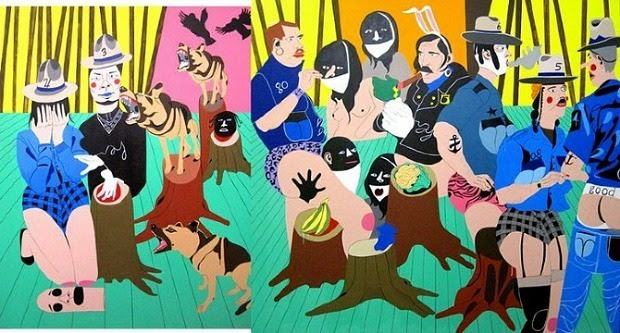
Image credits top to bottom: Nina Chanel Abney, Your gig is up, 2009; Rigoberto Torres, Daze, 1998, Fiberglass and acrylic on plaster cast; Huma Bhabha, Clifton, 2010; Jamel Shabazz, A time of innocence, 1980; Willie Cole, How Do You Spell America? #2, 1993. Headshot photo taken by Peter Serling
The Old Bronx Courthouse when it was still open and functioning as the Third Avenue El passed by / Image Courtesy of David Kopstein
As part of programming surrounding No Longer Empty’s exhibition at the Old Bronx Borough Courthouse, ‘When You Cut Into The Present The Future Leaks Out’, The New York Public Library’s ‘Community Oral History Program’, local community residents are invited to collect the oral histories of our neighborhoods of Melrose and Morrisania.
Once local residents are trained in interviewing our fellow friends, family members, neighbors and local residents and the interviews are completed, the results will be archived at the Melrose Public Library on Morris Avenue and 162nd Street as well as online for future generations to come.
The program begins this Thursday at the Old Bronx Borough Courthouse and the description is as follows:
“Cut Into the Past: Reclaiming Our Narratives” at the Old Bronx Borough Courthouse
Presented by No Longer Empty and the NYPL Community Oral History Program as part of the art exhibition: “When You Cut Into the Present, the Future Leaks Out” (April 23 – July 19, 2015)
Date: Thursday, May 14 from 6:30-8:00pm
Address: 878 Brook Ave (at East 161 St and Third Ave)
Directions: 2 or 5 train to 3 Ave-149 St
Join No Longer Empty and the New York Public Library Community Oral History Program as we invite the Melrose and Morrisania communities back into the Old Bronx Borough Courthouse to collect diverse accounts about the historic landmark building, and surrounding neighborhoods.
NYPL Adult Programming Coordinator Alexandra Kelly will inaugurate this unique archive with an interview from Anthony Schepis, former Executive Assistant District Attorney at the Bronx DA’s Office, to be followed by information on how to participate by interviewing your own neighbors, family, and colleagues who lived and worked in and around the Old Bronx Borough Courthouse.
Community Oral History interviews will continue on an ongoing basis at 878 Brook Avenue through July 19, 2015 and will be collected and archived at the New York Public Library for use by future generations.
Thursday’s Kick-Off event will be followed by Interviewer Training Sessions on the following dates:
Saturday, May 16 10am -12pm.
Thursday, May 19 6:30pm – 8pm.
To RSVP please visit No Longer Empty’s event page at nolongerempty.org.
More information about the New York Public Library’s Community Oral History Project can be found at oralhistory.nypl.org.
Charlie’s Bar and Kitchen started offering lunch this week due to popular demand and now, starting in June, Morris Perk will be popping up at Charlies during weekdays for breakfast in what the two businesses are calling CBK Perk!
Charlie’s has been a very popular destination for dinner, drinks, brunch, and happy hour among locals and Bronxites from all corners of our borough and now folks working in the area (or not!) have another reason to go to Charlie’s and much earlier too.
But that’s not even the best part. The wonderful part is how two small Bronx businesses are coming together to support each other, and with that, will introduce each other’s followers to one another.
Morris Perk has been popping up at local events and businesses across the borough for some time now establishing a loyal following, much like Charlie’s has in a brick and mortar setting.
CBK Perk will be providing a continental breakfast in the beginning along Morris Perk’s signature coffee blend, espresso drinks, juice of the day, and organic teas from Loose Leaf Tea Company.
Lovie Pignata, proprietor of Morris Perk said about CBK Perk, “To be a small business you have to be fluid and open to opportunities that others might deem too ‘out of the box’. We were thrilled to be invited to operate within a popular existing restaurant like Charlie’s.”
“When I began Morris Perk, I thought I’d open my storefront and business would just flow. Because of the delays with our primary location on Holland Avenue, I focused on working with community organizations and other small businesses. It’s been rewarding and the feedback has been so helpful in developing a small business.” added Pignata.
Personally, I love both businesses and the folks who run them so I think this is gonna be wonderful to have another spot for breakfast in the neighborhood.
Both businesses support the local community and that kind of giving back to the our neighborhoods is what makes The Bronx special.
Lovie is excited to be working on this side of the Bronx River. “Over the last year, we have popped up in every corner of the Bronx and we look forward to working with Charlie’s Bar and Kitchen and being part of the Port Morris and Mott Haven community.” she told us over some of her coffee blend.
Can’t wait for June to get here! In the meantime, if you have any requests, feel free to let them know!
Lunch at Charlie’s! Image courtesy of Charlie’s Bar and Kitchen
Oh and don’t forget, they’re now open for lunch Mon-Fri from 11:30AM – 3PM!
Photo of Morgan Powell via his Facebook Page / Photo By Charles Vasser
On Saturday, May 9th at 11AM, friends and loved ones of the late Morgan Powell will gather at Woodlawn Cemetery to finally bring him home and lay him to rest in his beloved borough and one of the places he loved so much.
From The Friends of Morgan Powell:
“We will all gather at the Woolworth Chapel at Woodlawn Cemetery to pay our respects and celebrate the life of an amazing man, Morgan Powell. We have the chapel for ONE hour. The closest entrance is the Jerome Ave entrance. Immediately following the service we will be making our way to Brookside (on the opposite side of the cemetery) and meet at Morgan’s memorial rock. Cars are allowed, but bikes, roller skates, scooters, skate boards and the like are NOT. It is a four minute drive, but a 20 minute walk. Please plan accordingly and transportation cannot be provided. The memorial rock is closer to the 233rd Street/Webster Ave entrance. If you have any questions, please feel free to send us a message. Thank you. Friends of Morgan Powell”
Bomba dancing last year at a block party in Port Morris
When you split $130,000 among 6 cultural institutions, it may not sound like much, but every bit helps as funding, grants, and charitable donations become tougher to come by each year.
Thanks to The National Endowment For The Arts, six local Bronx institutions will be able to either continue or provide additional programming.
With so many school children— particularly those living in economically disadvantaged neighborhoods of The Bronx—disproportionately cut off from arts programs in schools, these institutions provide a vital outlet to both our youth and their families to experience the benefits of such programming.
“At-risk students who have access to the arts in or out of school also tend to have better academic results, better workforce opportunities, and more civic engagement, according to a new NEA report, The Arts and Achievement in At-Risk Youth: Findings from Four Longitudinal Studies. The study reports these and other positive outcomes associated with high levels of arts exposure for youth of low socioeconomic status.” (Read a more detailed breakdown on the findings of how arts education benefit our at-risk youths.)
The $130,000 in funding will be distributed as follows as per Congressman Serrano’s press release:
Bronx Council on the Arts, Inc. – $25,000
To support a professional development series of workshops.
The project will elevate the quality of submissions by Bronx artists for fellowships and grants and contribute to the health of arts and culture in the Bronx in general. Additionally, the series will connect artists with professionals in their fields who will provide specific advice and technical assistance about how to succeed in their disciplines. The eight-part series comprising free presentations will be geared to reaching the filmmaking, literary, theater, visual arts, and performance communities, as well as small businesses.
Bronx Documentary Center Inc – $15,000
To support a documentary photography exhibition series and related public programming.
The series will present works by photographers, filmmakers, and photojournalists who deal with the themes of justice, education, and social change. Selected photographers may include Hiram Maristany, Kadir Van Louhizen, and Eugene Richards. Film screenings, artist presentations, and panel talks will be offered to stimulate debate and discussion. A specific curriculum will be developed to address critical thinking skills related to documentary photography. Exhibition tours will be offered to local middle schools, high schools, and community groups.
Dancing in the Street, Inc. – $20,000
To support Dancing through the Bronx, a festival of free performances that will engage diverse neighborhoods in the Bronx.
The festival will take place at Wave Hill, Hayden Lord Park, Owen Dolen Park, and Roberto Clemente Plaza. The program will feature “Bolero Bronx,” a site adaptive version of Larry Keigwin’s Bolero project, featuring Keigwin + Company dancers and community members. Other project components will include Latin dance with live music, site-specific dances, and a culminating salsa dance party. Artists under consideration for the Latin dance component include Frank Muhel, Eddie Torres, Jr., and Danza Fiesta. Choreographers under consideration to create site-specific dances include Reggie Wilson, Wally Cardona, Nora Chipaumire, and Paloma McGregor. Emerging or mid-career choreographers will be commissioned for as many as five site-specific performances that will take place during continuous loops in the gardens of Wave Hill.
Eugenio Maria de Hostos Community College Foundation – $30,000
To support BomPlenazo, Ninth Biennial of Afro-Puerto Rican Culture.
The festival will include a series of concerts featuring dancers and musicians from New York City and Puerto Rico. The event also will feature workshops for percussion, singing, dance, and a special workshop for children. Also planned are a series of lectures, demonstrations, and films exploring the evolution of “bomba” and “plena,” percussion-driven musical traditions from Puerto Rico, NEA Heritage Fellow Juan Gutierrez will participate as both a performer and lecturer.
Pregones Touring Puerto Rican Theatre Collection, Inc. – $30,000
To support a production of “The Bolero Was My Downfall,” an English-language translation of an original ensemble play with music.
Originally produced in Spanish and adapted from a story by Puerto Rican author Manuel Ramos Otero, the work tells the story of an aging transvestite and convicted murderer serving out the last days of a prison sentence.
Women’s Housing and Economic Development Corporation – $10,000
To support the Bronx Music Heritage Center’s Living Legends Performance Series.
Concerts at venues in the Bronx, such as The Hostos Center for the Arts & Culture, will honor and celebrate master Bronx musicians for outstanding contributions to their artistic field and community as artists, educators, activists and advocates. Each concert will include an onstage interview and a musical performance, which will either feature or be curated by the respective honoree. Previous honorees include DJ Kool Herc, jazz pianist Bertha Hope, and Latin jazz bassist Andy Gonzalez.
As seen in Mott Haven on 140th and Brook Avenue…a sign of things to come?
Coming Soon: Bushwick…If We Let It.
The following is syndicated from CityLimits and is very appropriate and applicable to The Bronx as signs of gentrification continue to manifest itself in the South Bronx. Is this what Bronx residents have to look forward to as developers are given free reign by our politicians to come into our neighborhoods and development with rampant disregard?
New York City has become a sterile, cookie-cutter “suburban” city. Neighborhoods in Manhattan and many parts of Brooklyn no longer have a distinct character or are losing them and becoming more homogeneous. Is this what we really want to happen to The Bronx?
Displaced, Dispersed, Disappeared: What Happens to Families Forced Out of Bushwick?
Everyone knows higher rents have forced many families out of their apartments in rapidly gentrifying Bushwick. But no one has bothered to count them or figure out where they went.
Bushwick has been in the national spotlight of late, the latest neighborhood to be emblematic of the New Brooklyn of hipster beards and trendy clubs. There’s now an artisanal Bushwick-scented candle you can buy for $81 (“scent highlights include terpentic notes of drying oil paint on canvases”), and Saturday Night Live officially ushered Bushwick stereotypes into the comedic mainstream with a sketch—actually filmed in upper Manhattan — parodying neighborhood black youth talking trash about their gelato purchases.
The new Bushwick is very real: Census data show that the white population, while still a minority, has soared, and young white faces are now common sights far out onto the J and L train lines. It’s a transition that has sent rents soaring, and prompted media attention to the often illegal means that landlords have used to clear out existing residents to make way for deeper-pocketed replacements.
What has drawn less attention is what’s happening to the old Bushwick as it gets displaced. In the decades after the fires and post-blackout looting of the 1970s made the neighborhood a symbol of New York’s decline (and earned it a starring role in the 1977 mayoral race that put Ed Koch in Gracie Mansion), the neighborhood rebounded with new low-rise city-subsidized housing and new residents, largely from Mexico and Central America. The drug trade that once plagued the area — Maria Hernandez Park, the neighborhood’s central open space, was renamed in the 1990s for a local community activist who was shot and killed through her bedroom window for her organizing against local crack dealers — was dispersed, and the old neighborhood of brewery workers became a draw for largely Spanish-speaking families seeking reasonably priced housing and decent schools.
Now, those residents are rapidly moving out — between the 2000 and 2010 censuses, the number of Hispanic residents in the 11237 zip code dropped by more than 9 percent, even as the overall population increased — and no one at any level of government can say where they’re going. (SNL notwithstanding, the dominant ethnicities in Bushwick are Mexican and Puerto Rican more than black.) No government agency — not the U.S. Census Bureau, not City Hall, not the local community board, not even the Department of Education — keeps statistics on relocation within specific neighborhoods, leaving only rumors of people departed to eastern Brooklyn, to Queens, even to New Jersey or Pennsylvania.
“I don’t know where people are going, is the bottom line,” admits Mirtha Duran, who runs the Ridgewood Bushwick Senior Citizens Council’s HomeBase shelter diversion program. “Certainly, some of them are entering shelter. The rest are moving to cheaper neighborhoods.”
“When I hear from families, a lot of them are moving to Rockaway and East New York and Elmhurst,” adds Jenny Akchin, a volunteer lawyer with the Bushwick Housing Independence Project, which represents local tenants fighting eviction. Yet “No one is particularly tracking it, and I find that kind of concerning.”
Bushwick’s demographic shift, all agree, took off in the years after the rezoning of the Williamsburg waterfront in 2006 drew new, wealthier residents to that neighborhood, forcing young people, most of them white, to seek more affordable housing — affordable, that is, by Williamsburg standards — further east along the L subway line. Some were lured by new construction — the Colony 1209 condo drew particular attention for its over-the-top frontier rhetoric, announcing it would be marketing itself to “like-minded settlers” — but most of the newcomers have benefited from the conversion of existing rental units from single families to groups of young people, with an attendant soaring of rents.
According to Census data interpreted by the city Department of City Planning, Bushwick saw a net in-migration of 9,155 non-Hispanic whites from 2000 to 2010, more the tripling the previous figures for the neighborhood. Meanwhile, after accounting for births and deaths, a net of 17,440 blacks and Hispanics moved out, nearly 16 percent of that population that lived in Bushwick in 2000. And the 2010 Census data, by all accounts, leaves out the biggest wave of displacement, which has accelerated since both the rezoning and the recovery from the Great Recession.
BHIP housing advocate Yolanda Coca says the pace of evictions took a large jump around 2011, the year after the Times dubbed Bushwick “the coolest place on the planet” for those seeking a bohemian lifestyle. She says some longtime residents are leaving the city entirely, while others are doubling up, or taking on roommates: “It’s a very tough situation. I see people getting crazy looking for another place to move out when the landlord is pushing them out.” When she called one recent client to invite her to a meeting, she says, she was told that she was now living in Philadelphia.
Exactly where people are moving from Bushwick is impossible to say. The Census Bureau’s annual American Community Survey asks residents where they moved from since the previous year — but only tracks that to the county level, meaning it’s impossible to separate out those who relocate from Bushwick from those who migrate from Park Slope or Coney Island. The Internal Revenue Service likewise keeps records of who moves where, but only releases it aggregated by county.
On the city level, meanwhile, only the Department of City Planning has attempted to investigate migration from gentrifying neighborhoods, and so far only by crunching the existing Census data, meaning detailed migration information isn’t available. The Department of Education, which could examine school registration records, doesn’t release data on movement of school-age children between districts.
That leaves anecdotal accounts from Bushwick residents and tenant advocates. They paint a picture of former neighbors being scattered to the four winds, mostly ending up wherever they can find lodging, even if it’s in unfamiliar communities far afield.
For Elia Colon, who first settled on Greene Avenue in Bushwick in the 1980s, the first sign of trouble came after she’d spent several months waiting for her landlord to fix the leaky ceiling in the Greene Avenue row house where she’d lived for more than two decades. Instead she received a phone message from an unfamiliar voice, saying he was the building’s new owner.
“He said, ‘Oh, Ms. Colon, I’m calling you because this is urgent – you have to move because the city department is threatening to shut off the water and the lights,’” she recalls. “And I said, ‘This man is crazy, what does he think I’m stupid or something?’ I called him back and was furious, I said, “What are you talking about, I’m not stupid! I pay my lights, and what do I have to do with the water?’ ‘Ah, no, but you have to move.’ I said, ‘Who are you?’”
(This is a common practice among Bushwick landlords, says Akchin: “Many of our cases are families where their buildings came under new management, and they didn’t have a lease, and there’s nothing they can do except bargain for additional time to move.”)
Colon stayed put at first, but ended up in a months-long battle with her new landlord. “This thing went on and on. Every time he called me: ‘Oh, you have your apartment? When are you moving?’ I said, ‘Stop harassing me!’”
Eventually, after years of legal battles and [treatment for stress], Colon was able to buy a co-op in Woodhaven. But she still misses her old home. “Since 1973 I used to go to that church,” she says. “I’m far but I still go over there, because it’s like my second home.”
Ricardo Maesa was lucky, in a manner of speaking: After his landlord cleared out all the tenants from his building on Irving Avenue, his family was able to find a new rent-regulated apartment around the corner on Stanhope Street — albeit for an extra $400 a month, and with worse conditions. (“In the other apartment, there weren’t any rats.”) He now has no money left over from his job at the nearby Home Depot for living expenses beyond rent, something that many of his neighbors have fled rather than face: “I think people are going to Jamaica.”
Joel and Maria Najera, who 10 years ago moved to a rent-stabilized apartment on DeKalb Avenue in search of better schools for their kids than they could find in their old neighborhood of East New York, say they’ve watched as their landlord has, through a combination of offering cash for tenants to move and constant harassment, cleared out four of the apartments in their six-unit building. “People came and said the landlord said, ‘You need to get out this week’ — three times, different people,” says Joel. One of them, recalls Maria, told them they had to leave, “because he was going to burn the building.”
One of their neighbors, the Najeras say, agreed to move to another apartment nearby, but “after four years the rent rose too high and they couldn’t pay it.” Priced out a second time, she says, that neighbor ended up moving to Jamaica, Queens; the others, who took buyouts of up to $15,000, she has long since lost track of. They’ve been replaced, she says, with groups of new tenants willing to pay as much as $3,000 to share a two-bedroom apartment that previously rented for less than half that amount. (The Najeras are currently fighting their own eviction in housing court, with the help of Make the Road New York.)
One reason they’re forced to leave the neighborhood, say numerous residents, is that Bushwick landlords won’t rent to families with children — something that is a common practice despite being illegal under the federal Fair Housing Act. “When you call the number and ask do you have an apartment for rent, the first question he asks is if you have children,” says Diana Zarumeno, who along with her husband and three pre-school-age kids was evicted from her Bushwick apartment and ended up having to move across the Queens border to a more expensive apartment in Ridgewood. Kids, say landlords, are noisy and can cause damage to apartments. When she called realtors to ask about available apartments, says Zarumeno, the answer was always, “‘If you have children, then no, the apartment is already rented.'”
Maesa says he was told the same: “He said with kids you can’t find any [apartments].” On top of that, he says, he received another warning from one landlord: “I’m Ecuadorian, you know, and I don’t know why he said it, but he said, ‘You know, you can’t rent these areas to Ecuadorians.’”
Maria Najera says that with two teenage kids, looking for a new space apartment in Bushwick has been absolutely impossible. Her landlord, she says, told her “he would rather rent to a white man with a dog than to me with my kids.”
Both residents and advocates say there are, for now, still a handful of neighborhoods where low rents are available. But relocating comes with costs — in addition to a rent hike, Maesa and his family had to cobble together three months’ rent to give to their new landlord and broker — and means switching schools, and often giving up the safety and community that they moved to Bushwick to find. Without her apartment, says Najera. “I would have to move to a place where there are gangs, pandillas, where my kids won’t be safe.”
And with their friends and neighbors scattering, displaced Bushwick residents lose something else as well: the community ties that have slowly re-knit the neighborhood after the devastation of the 1970s. “Your church, it’s a very important piece of your life,” says Coca. “My church is my second home — half of my life is here. And people been losing all of that.”
Coca says she wonders what will be left of the old Bushwick in another 10 years. Meanwhile, the few remaining affordable neighborhoods are already in developers’ sights, leaving New York’s nearly four million poor and near-poor residents squeezed into less and less space.
HomeBase director Duran says her agency has relocated Bushwick residents to more affordable Brooklyn neighborhoods like Brownsville, East New York, and Canarsie, or even to the Bronx, but wonders how long those options will still be available. “We joke around and say, ‘Where are we going to put poor people, in the Atlantic Ocean?'” she says. “Is this going to continue in Brooklyn? Is Bushwick the frontier, or is there more beyond Bushwick?”
A packed room where every seat was taken and people were still coming in as the presentation began, soon emptied out leaving behind a fraction of residents who attended.
On Tuesday, May 5th, the South Bronx Overall Economic Development Corporation—better known as SoBro—held a “second” visioning session on the Special Harlem River Waterfront District to discuss the issues of developing the waterfront, residential, needs, and gentrification issues.
Tucked away in a corner, the 1st waterfront “visioning session” was obviously not the main reason this event was held.
The reason I say second in quotes is because SoBro held a block party last year where they had a small station in a corner—away from the center of pedestrian traffic and flow—where they collected surveys about the waterfront. Surveys that were never heavily promoted. Many residents were unaware that a “first” session had occurred. In fact, these are the very words SoBro used to describe the event held last year on June 14th:
“Join us for a day of food, dance and music! Enjoy performances of Salsa, Bomba / Plena, Hip-Hop, and special performances by the Hip Hop Legends: Grand Wizzard Theodore, Grand Master Melle Mel, Soul Sonic Force, and Curtis Blow. Restaurants will open their doors to showcase some of the best food the Bronx has to offer! This event is FREE to the public.”
Sounds like an invitation to a block party, not a “Visioning Session”. Sure they made sure to place the words there but they did in small print below what they obviously considered to be the most important part of the event.
No mention at all about this being a visioning session on the waterfront except in tiny print on the flyers. Worst of all, the survey was in English only neglecting the huge population in the area that is Spanish or French speaking only.
At Tuesday’s “visioning session” they provided a Spanish survey this time, however, it was obviously translated by using Google or an online translator.
The survey in Spanish was barely legible and confusing filled with misspellings, incorrect grammar, and phrases that don’t exist in the Spanish language. I was embarrassed for SoBro that they would have the audacity to issue such a sloppy document to the community which further makes people ask, “Does SoBro know the community they are supposed to be working for anymore?” It’s a slap in the face to the residents who live there.
SoBro is a community based organization that has been around for over 40 years and you would think that by now they would understand and know their audience.
It is also an organization that has received hundreds of thousands of dollars to conduct the study of the waterfront as it pertains to the Brownfield Opportunity Area and you think they would, at the very least, hire a professional translator for a few hundred dollars to accurately translate the survey.
The English version wasn’t any better and was actually quite offensive when it asked “What types of amenities would you like to see” and the first answer was “friendly neighbors”.
As someone who has worked in the real estate industry for over 15 years, that is completely unacceptable and is NOT an amenity and it borders on the illegal practice of steering if they were acting as real estate agents.
The survey also asked questions about what types of apartments they’d like to see in terms of number of bedrooms etc and what they thought was reasonable rent for a 1 bedroom apartment which went from $500 to $1000 and as high as $2,500 a month with the option to provide an alternate rent amount.
But enough about that.
The evening began with brief introductions and an overall of what SoBro does and has done in the community.
It was here where one revelation was made that was very disturbing and had several residents concerned.
According to SoBro, they manage every single Industrial Business Zone in The Bronx. This is a monopoly that is not acceptable by any means. No single organization should be in charge of such a delicate part of our economy.
During the presentation, SoBro admitted that they weren’t ready for so many people to show up as the room was packed to standing room only with people still streaming in.
SoBro also poorly planned the evening by not taking into consideration that people would want to speak and ask questions before the break out sessions into the various workshop groups—which is exactly what happened and people began to express concerns and make statements about SoBro’s handling of such a sensitive issue.
After folks spoke and the break out sessions began, many people simply walked out and contrary to what SoBro or other folks will tell you, a little more than half of those in the packed room were gone and instead they formed their own groups and discussions outside as the evening progressed.
At the core of why many were unhappy with the session was the fact that, yet again, this was not community engagement nor was the community consulted with from the beginning. A plan was created saying, “Here’s what we can do in the area” rather than “what would you like to see done in the area?”
There’s also the issue of why when the community demands safety, better amenities, parks, access to the waterfront, better schools, better transportation and the community is in CONSTANT advocacy on these issues no one listens but when money starts entering into the community from the outside and special interests are seeking to develop these strategic lands, all of a sudden these are issues to listen to.
Then what? So the existing community doesn’t count but now that there exists the very real probability that new residents of higher incomes will be coming in, NOW these amenities and services are of importance? Does not the existing population matter?
SoBro’s “first” visioning session doesn’t even mention the waterfront in their description.
It should be noted that many who stayed behind were either from SoBro, city agencies, board members of the Brownfield Opportunity Area and residents not from the immediate neighborhoods that would be directly impacted by what happens. Very few actual residents from the community stayed behind because of how disturbed they were by the presentation and having seen these types of “visioning” sessions before.
The common consensus was that this is already a done deal and SoBro is simply filling out check boxes so that they can say they complied with state regulations and had community engagement.
“Presenting a plan and then asking the community to comment is not participation. Holding one meeting, on a weeknight, for 40-50 people is not participation. Using the spectacle of “visioning” and participation to create the illusion of buy-in erodes the very foundation of community. A real participatory process starts with the community: what are our values? What are our hopes, dreams, and aspirations? Who are we, and what do we, collectively want?” said local resident, Elizabeth Hamby.
“Development is not necessarily a bad thing, but when the conversation is led by the developer and the community is merely consulted it creates the conditions for dislocation and displacement.” continued Hamby.
And Elizabeth Hamby is absolutely correct. Development isn’t necessarily a bad thing but when it is used as a tool without any real consideration for the existing residents, it then becomes a huge problem. Yes the lands, with the exception of two lots which are owned by the city, are private, but haven’t we already seen what happens when there isn’t a real exchange with the existing residents who are the ones that will feel the brunt of whatever is built (or not)?
At one point during the evening, a couple of residents walked by with signs in Spanish that read “Desalojo es violencia” or “Displacement is violence”.
Is it really our waterfront, our vision, our reality?
Joyce Hogi, also a resident further up on the Concourse who is actively present at many area meetings which concern our neighborhood and borough also echoed similar concerns to Hamby’s.
“What I saw was more “top-down” planning that was not really taking into account the needs of the community. We want to see development but responsible development that encompasses those who currently reside and work there. I suspect that this was an “exercise” to fulfill the obligation that they had gone to the community.” Hogi said.
Not everyone saw the exercise as futile.
Angel Molina, also a local resident and an individual who has political aspirations said, “It’s a David vs Goliath scenario, change is upon us. But, we’ve been here before. During last night’s meeting while some walked out, the majority stayed. We broke into small groups to discuss a variety of topics, which generated thought provoking and sometimes contentious discussion, especially on the subject of gentrification.”
Molina said they left, “…feeling optimistic because the venue provided an opportunity for community members of diverse backgrounds to come together and strengthen their connections. We all understood we had a limited say, but still wanted the opportunity to help shape the future of this community. The group was more than willing to not only share their ideas, but to lend a hand as well.”
Parkchester resident and local entrepreneur, Judith Ford said, “I enjoyed the open communication between the people there SoBro did a good job navigating the discussion. It was very informative and cool to see residents of the area new and native interact…there were great ideas shared and I really can’t wait to see the vision spread sheet that is going to cone of all the discussions. ”
Still, many others saw the flaws of the visioning session including individuals who have deep understanding of systemic issues that plague our communities and those that have worked in the front lines through activism.
“Open processes that engage a wider community of stakeholders are critical to any development project that will have a resonating impact to countless Bronx households. The suggestion made to create a community task force that will make this process more accessible is something that must materialize. More importantly, the recommendations and suggestions that come out of this engagement must be honored and diligently advocated for by community organizations like SoBro-whose first priority are the people in the neighborhoods they serve.” said April De Simone, co-founding partner of designing the WE and Bronx resident.
Come to the Bronx Documentary Center this Mother’s Day on Sunday, May 10th from Noon to 2PM for a free family portrait! Each Bronx family can get 1 FREE print with each additional copies and prints at $5 each. Non-Bronx residents pay $5 per print!
One of the 3 fully restored Ben Shahn murals at the Bronx General Post Office—10 more to go.
Now that the Bronx General Post Office is in the private hands of developer YoungWoo & Associates, work has begun on restoring the 13 iconic and landmarked Ben Shahn murals in the lobby.
The building, which opened on May 15, 1937 after 2 years of construction, was the largest of the 29 New Deal Era edifices built in New York City. In 1976 the building received landmark status from NYC’s Landmark Commission and in 2013, after Welcome2TheBronx broke the news that the United States Postal Service was selling the property, the interior lobby was granted landmark status as well—a feat that is not easy to achieve.
In the Landmarks Commission’s official designation of the interior as a landmark, they wrote:
“The Bronx General Post Office Building and its notable interior lobby were planned and constructed between 1934-37. The architectural design was executed by Thomas Harlan Ellett. The space contains a series of 13 mural panels created by noted artists Ben Shahn and Bernarda Bryson.
In the early 20th century—as the Bronx was becoming one of the fastest-growing urban areas in the country—it became apparent that the borough needed improved postal facilities. Efforts to secure a proper headquarters began as early as 1902, but it was only during the depths of the Great Depression and the advent of New Deal public works programs that the Bronx General Post Office was finally completed. Funding came from the Public Works Administration and the architectural design was overseen by the Federal government’s Office of the Supervising Architect, of which Ellett was a temporary employee.
The Bronx General Post Office and its lobby were designed in the Modern Classical style of architecture preferred by the New Deal-era public works programs. Ellett’s design combines modified classical ornament with a tendency to abstraction and simplification of these motifs. The double-height space features floor-to-ceiling Ionic columns, a striped marble and terrazzo floor, and a coffered ceiling with simplified rosette ornamentation. Materials include gray Missouri marble and white Tennessee marble, as well as complimentary terrazzo.
Integral to the design of the Bronx General Post Office Lobby was a series of murals, titled “Resources of America,” conceived by Shahn and completed with Bryson’s assistance. The artists won the commission through an open competition sponsored by the Section of Painting and Sculpture, a Federal agency closely aligned with the Office of the Supervising Architect. Per the requirements of the competition, Shahn’s designs comprise a unified decorative scheme that integrates with the architectural setting of the lobby. All of the panels relate to the general theme of Labor and depict dynamic, even heroic, views of the American worker. An acclaimed photographer as well as painter and graphic artist, Shahn often used photographs as the basis for his paintings. Several of the panels in the Bronx Post Office were clearly inspired by his photography trips to the American heartland during the 1930s, while others were derived from his extensive collection of newspaper clippings.
Draft versions of the murals were installed in the post office in December 1938 for public inspection and final approval. One of the panels, which included a portrait and quotation of Walt Whitman, drew intense criticism for the perception that the poet questioned the place of religion in modern society. Seeking to avoid controversy, Shahn modified the text with a different quotation. Installation of the murals occurred early the following year and all 13 panels were completed by August 1939. Reception of the murals was almost universally favorable; contemporary accounts praised them for their “real social significance as well as being beautiful compositions,” the artist’s obituary cited the Bronx works as major mural commissions, and many recent art history texts mention the paintings as amongst the best examples from his most productive period.
The Bronx General Post Office has continued to serve its original purpose since it opened in 1937. The murals have been restored on at least two occasions and the lobby underwent extensive renovations, all of which occurred in the 1970s. In spite of alterations that have occurred to the interior space, the Bronx General Post Office Lobby retains much of its original fabric and Modern Classical architectural design. The notable series of murals executed by Shahn and Bryson are intact and are still situated in their original context. The structure—whose design incorporates a significant synthesis of architecture, sculpture, and painting—remains a monument to the ideals of the New Deal-era public works programs.”
One of the 3 murals currently being restored is sealed off as preservationists work 6 days a week to restore the murals to their former grandeur.
For the past several months, 6 days a week, an expert team of preservationists have been meticulously cleaning the murals and then painstakingly retouching whatever parts have been damaged whether through aging or poor prior retouching. Once finished, a special thin glaze is applied to protect the murals.
Three of the 13 murals have already been completed with 3 currently being worked on at the moment.
Gift To Empower providing hundreds of Bronx school children with the basic necessities to start out the school year on the right path. Many families do not have enough money to purchase the bare minimum their children need.
When Flora Montes, founder and President of Bronx Fashion Week started the organization, she always said that she always meant for it to give back to the community.
This weekend, at The Old Bronx Borough Courthouse during No Longer Empty’s exhibition ‘When You Cut Into The Present The Future Leaks Out’ will be no exception.
Hosted by La Bruja, this Saturday, May 9th, the event will include poetry readings and live entertainment. A percentage of the proceeds raised during the event will go to “Gift to Empower” a 501(c)(3) (pending) organization which has helped over 4,000 Bronx children in need in the past 10 years, particularly those living in shelters, where they receive a backpack filled with school supplies for the new school year.
This year, the organization plans on assisting at least 1,000 children. You can contribute to the cause by purchasing a ticket (for 30% discount on general admission tickets, use code MOM!) or you can make donations on the spot!
Please note: Since the 501(c)(3) status is still pending, ticket sales and contributions are currently not tax-deductible but will be retroactive once “Gift to Empower” receives its official approval–anticipated to happen in the coming months.
Disclaimer: Ed García Conde is Vice President of Marketing and Public Relations at Bronx Fashion Week™ along with Welcome2TheBronx™ as one of the many community sponsors.